
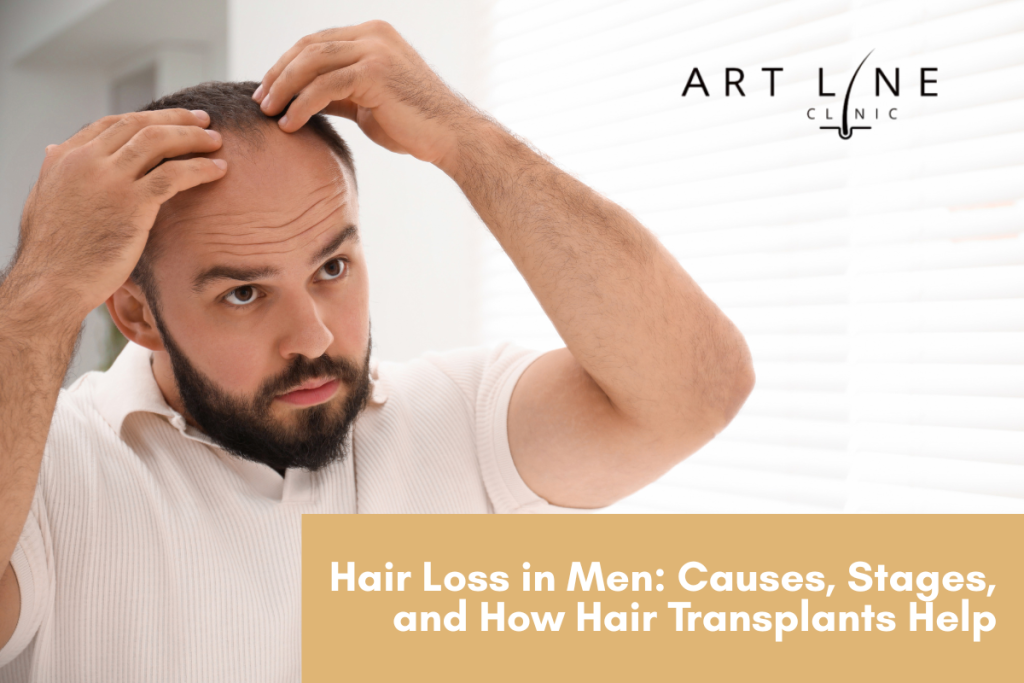
What Causes Hair Loss in Men?
The most common cause is androgenetic alopecia, also known as male pattern baldness.
1.- Genetics
Hair loss is often inherited. If male relatives experienced thinning or baldness, the likelihood increases.
2.- Hormones (DHT Sensitivity)
Dihydrotestosterone (DHT), a derivative of testosterone, shrinks hair follicles over time. This process shortens the hair growth cycle and produces thinner strands.
3.-Age
As men age, hair growth slows naturally. Follicles become less active, and density decreases.
4.-Stress and Lifestyle
Although genetics play the largest role, factors such as stress, poor diet, smoking, and medical conditions can accelerate thinning.
The Stages of Male Pattern Baldness
Hair loss in men typically follows a predictable pattern, often classified using the Norwood Scale.
Stage 1–2: Early Receding Hairline
- Slight temple recession
- Minimal thinning
Stage 3–4: Noticeable Hairline and Crown Thinning
- Deeper recession
- Visible thinning at the crown
Stage 5–6: Advanced Hair Loss
- Larger bald areas
- Thinning bridge between hairline and crown
Stage 7: Extensive Baldness
- Limited donor area remains
Understanding your stage helps determine the best treatment plan.
Can Hair Loss Be Stopped?
Some treatments can slow progression:
- Medications
- Lifestyle improvements
- Medical therapies
However, these options do not restore lost follicles.
How Hair Transplants Help Men with Hair Loss
Hair transplantation addresses the root cause of male pattern baldness by relocating genetically resistant follicles from the donor area to thinning zones.
Because donor hair is resistant to DHT, it continues growing permanently in the new location.
Learn more in Is a Hair Transplant Permanent? Results, Longevity, and Maintenance.
Benefits of Hair Transplants for Men
- Natural-looking hairline design
- Permanent solution
- Minimal maintenance
- Improved confidence
- Ability to style and cut hair normally
Modern techniques such as FUE and FUT allow for precise, customized results.
Explore technique differences in FUE vs FUT Hair Transplant: Which Technique Is Right for You?
When Should Men Consider a Hair Transplant?
Ideal timing depends on:
- Stability of hair loss
- Donor area density
- Long-term planning
See qualification factors in Signs You Are a Good Candidate for a Hair Transplant.
Psychological Impact of Hair Loss
Hair loss can affect:
- Self-esteem
- Professional confidence
- Social interactions
Many men report significant emotional improvement after hair restoration.
Final Thoughts
Hair loss in men is common, but effective solutions exist. A hair transplant provides a permanent, natural-looking option for those seeking long-term restoration.
The key is professional evaluation and strategic planning.
Ready to restore your hairline and confidence?
Schedule a consultation with Artline Hair Clinic and receive a personalized hair restoration plan.